
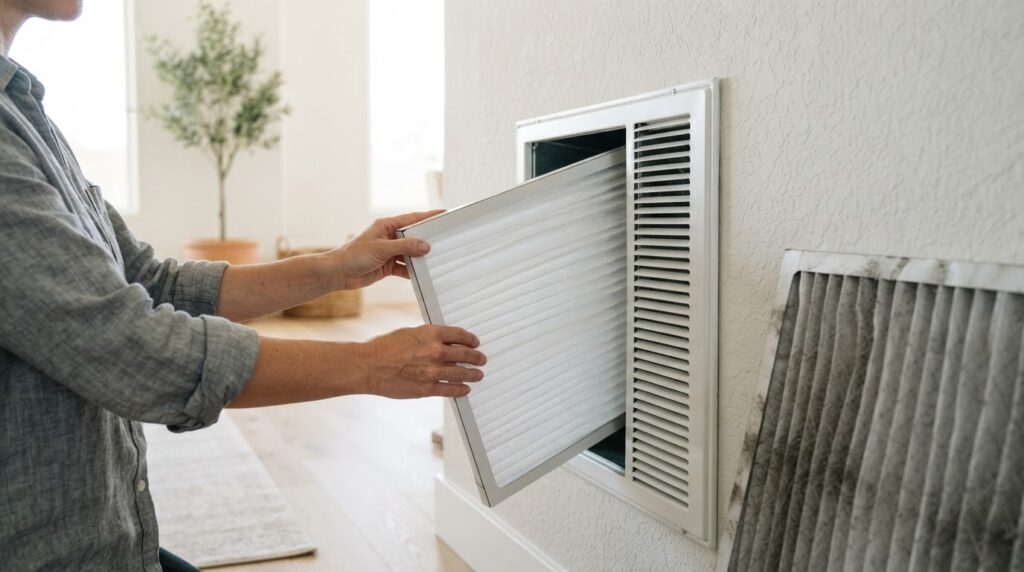
If you’re wondering how often to change AC filter in Las Vegas, the short answer is every 30 to 60 days for a standard 1-inch filter during the cooling season. If you have pets, allergies or a lot of dust, check it every 2 to 3 weeks and replace it as soon as it looks gray. Thicker 4- to 5-inch media filters last longer, but they still need a monthly look. In the desert, your air conditioner runs for much of the year and pulls in fine dust every day, so filters clog faster than the “every 90 days” rule printed on many packages.
Below you’ll find a simple schedule by filter type, the signs your filter is overdue, how to pick the right MERV rating and a quick step-by-step guide to swapping it yourself.
Why Does the AC Filter Matter So Much?
Every bit of air your system cools passes through the filter first. A clean filter traps dust, pet hair and pollen before they reach the blower and the indoor evaporator coil. A clogged filter chokes that airflow, so the system runs longer to reach the thermostat setting.
According to the U.S. Department of Energy, swapping a dirty, clogged filter for a clean one can lower an air conditioner’s energy use by 5% to 15%. The DOE’s air conditioner maintenance guide also notes that dusty conditions, constant use and pets all mean checking filters more often.
What a Dirty Filter Can Do to Your System
- Higher power bills: restricted airflow makes the system run longer cycles.
- Frozen evaporator coil: too little warm air across the coil can let it ice over, which stops cooling.
- Water leaks: when that ice melts, it can overflow the drain pan. It’s one of the common causes we cover in reasons your air conditioner is leaking water.
- Dirty coils and ducts: air that slips around a clogged filter carries dust straight onto the coil.
- Extra wear: the blower motor works harder, which adds stress during long summer runs.
How Often to Change AC Filter in Las Vegas Homes?
The right schedule depends mostly on the filter’s thickness and your household. Use this table as a starting point, then adjust based on what you see at your monthly check.
| Filter type or situation | Typical desert-home schedule |
|---|---|
| 1-inch fiberglass (basic, flat) | Every 30 days |
| 1-inch pleated | Every 30–60 days |
| 2-inch pleated | Every 60–90 days |
| 4- to 5-inch media filter | Follow the manufacturer’s interval, but check monthly |
| Washable/reusable filter | Rinse and fully dry about once a month |
| Pets, allergies, smokers or nearby construction | Check every 2–3 weeks; replace as soon as it looks gray |
| After a dust storm | Check within a day or two |
Why the Desert Shortens Filter Life
Southern Nevada homes face a few things that clog filters quickly. Long cooling seasons mean more hours of airflow through the filter. Fine desert dust works its way inside through doors, windows and small duct leaks. Spring winds and summer monsoon dust storms can load a filter in a matter of days.
In winter, if you heat with a furnace or heat pump, the same filter is doing the job again. Keep checking it through the cooler months instead of forgetting it until the next summer.
What MERV Rating Should You Use?
MERV (Minimum Efficiency Reporting Value) tells you how well a filter catches small particles. Higher numbers trap finer dust, but they can also restrict airflow on systems that weren’t designed for them.
- MERV 1–4: basic fiberglass filters that mainly protect the equipment from large debris.
- MERV 8–11: a common, balanced choice for most homes, catching dust, pollen and pet dander.
- MERV 13 and up: better at very fine particles, but check your equipment’s specifications or ask a technician first, since a dense 1-inch filter can starve some systems of air.
If you want cleaner air without the airflow trade-off, a thicker media cabinet or a whole-home air filtration system can filter finely while keeping air moving. For more on how your system affects the air you breathe, see the role of an AC in improving indoor air quality.
What Are the Signs Your AC Filter Needs Changing?
- The filter looks gray or brown, or you can’t see light through a pleated filter.
- Weak airflow from the vents, even with the system running.
- More dust settling on furniture than usual.
- Your power bill jumps without a change in thermostat settings.
- The system runs longer cycles or struggles to reach the set temperature.
- Ice on the refrigerant lines or the indoor unit.
If you replace the filter and still see ice, weak airflow or poor cooling, the problem may be deeper, such as a dirty coil or a refrigerant issue that needs a licensed technician. Our AC tune-up service includes a full system check, so small problems get caught early.
How Do You Change an AC Filter?
Changing a filter takes about five minutes and no special tools.
- Turn the system off at the thermostat so it doesn’t pull dust in while the slot is open.
- Find the filter. It’s usually behind a return air grille in a wall or ceiling, or in a slot at the air handler or furnace.
- Note the size and direction. The size (for example 20x25x1) is printed on the frame, and an arrow shows the airflow direction.
- Remove the old filter carefully so the dust stays on it, and bag it for the trash.
- Insert the new filter with the arrow pointing toward the blower, away from the room.
- Close the grille or panel and turn the system back on.
- Write the date on the filter frame or set a phone reminder for next month’s check.
Tip: buy filters in multi-packs in the exact size your system uses. Having one on hand makes it much easier to stay on schedule.
Frequently Asked Questions
Is it OK to change an AC filter every 3 months in Las Vegas?
For thicker 2-inch or 4-inch filters it can be, but most 1-inch filters in desert homes clog well before 90 days. Check the filter every month and replace it whenever it looks dirty, regardless of the date.
What happens if I never change my AC filter?
Airflow drops, energy use rises and the evaporator coil can freeze or get coated in dust. Over time this can lead to water leaks, poor cooling and extra strain on the blower motor.
Can a dirty filter stop my AC from cooling?
Yes. A badly clogged filter can let the coil ice over, which blocks airflow and stops cooling. Turn the system off, replace the filter and let the ice melt; if it happens again, have a technician inspect the system.
Do I need to change the filter in winter too?
Yes. Furnaces and heat pumps use the same filter, so it keeps collecting dust whenever the blower runs. A monthly check year-round is the easiest habit to keep.
Need Help Keeping Your AC Running Clean?
Changing filters on time is one of the easiest ways to protect your system, but it’s only one part of keeping an AC healthy through a Las Vegas summer. If your system is struggling, freezing up or running nonstop, Airtech1 LLC can take a look. Request a free quote online or call us at (702) 688-2885.