
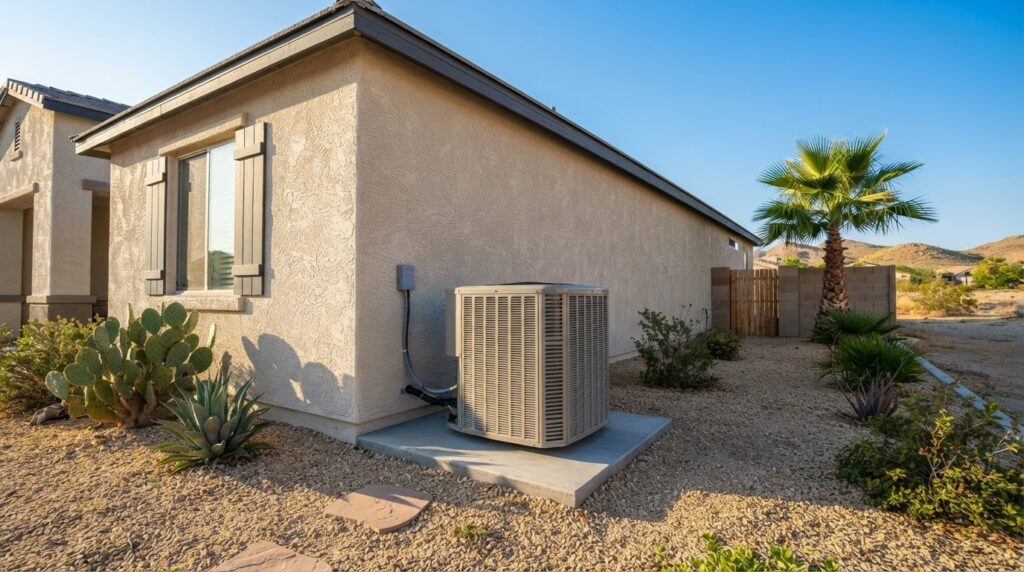
If you’re asking what size AC do I need for a 2000 sq ft house, the usual answer is somewhere between 3 and 5 tons of cooling (about 36,000 to 60,000 BTUs). A common starting estimate is 20 BTUs per square foot, which puts a 2,000 sq ft home at roughly 40,000 BTUs, or about 3.5 tons. In hot desert climates, many homes end up toward the higher end of that range, but the only way to know your exact number is a proper load calculation.
Below, we’ll explain what tons and BTUs mean, the rough math, the things that push the number up or down, and why buying a bigger unit than you need causes its own problems.
What Do Tons and BTUs Mean for an Air Conditioner?
AC size has nothing to do with how big the outdoor unit looks. It describes cooling capacity: how much heat the system can remove from your home in an hour. That capacity is measured in BTUs (British Thermal Units) per hour.
One “ton” of cooling equals 12,000 BTUs per hour. So a 3-ton system removes about 36,000 BTUs per hour, and a 5-ton system removes about 60,000. Central systems for homes are usually sold in roughly half-ton steps, and most residential split systems top out at 5 tons. Larger homes often use two systems instead of one very large one.
What Size AC Do I Need for a 2000 Sq Ft House in the Desert?
Rules of thumb give you a ballpark, not a final answer. Here’s how the common estimates work out for 2,000 square feet:
| Home situation | Rough estimate | Approximate size |
|---|---|---|
| Mild climate, good insulation | About 600 sq ft per ton | 3 to 3.5 tons (36,000–42,000 BTU) |
| Common 20 BTU per sq ft baseline | 40,000 BTU | About 3.5 tons |
| Hot climate, average insulation | About 500 sq ft per ton | About 4 tons (48,000 BTU) |
| Extreme heat, older home, lots of west- or south-facing glass | About 400 sq ft per ton | Up to 5 tons (60,000 BTU) |
Southern Nevada summers regularly push past 110°F, so a typical 2,000 sq ft home here often lands in the 3.5- to 5-ton range. Two houses with the same square footage on the same street can still need different sizes, which is why these numbers are only a starting point.
What Factors Change the Right AC Size?
Square footage is just one input. These details often matter as much or more:
- Insulation and attic: a well-insulated attic keeps heat out of the living space. Thin or settled insulation raises the load.
- Windows and sun exposure: large west-facing windows, older single-pane glass and missing sun screens add a lot of heat in the afternoon.
- Ceiling height: vaulted or 10-foot ceilings mean more air to cool than standard 8-foot ceilings.
- Ductwork location and condition: ducts in a hot attic gain heat before the air reaches your rooms, and leaky ducts waste cooling.
- Air leakage: gaps around doors, windows and attic openings let hot air in.
- Layout and stories: two-story homes and long, spread-out floor plans can be harder to cool evenly.
- People and appliances: more occupants, home offices and heat-producing equipment all add to the load.
Is a Bigger AC Better?
No. It’s one of the most common mistakes in air conditioning. An oversized system cools the air quickly, hits the thermostat setting and shuts off, then starts again a few minutes later. This is called short cycling.
Problems With an Oversized AC
- Frequent starts put extra wear on the compressor and electrical parts.
- Rooms far from the thermostat can stay warm while the hallway feels cold.
- Higher upfront cost for equipment you don’t need.
- In more humid weather, such as monsoon season, short runs remove less moisture, so the house can feel clammy.
Problems With an Undersized AC
- The system runs nonstop on the hottest afternoons and still can’t reach the set temperature.
- Constant running adds wear and drives up power bills during peak hours.
- Upstairs rooms and west-facing rooms can stay uncomfortably warm.
Variable-speed and two-stage systems can soften some of these trade-offs because they run at lower output most of the time and ramp up only when needed. You can learn more about variable-speed AC systems and how they handle long desert summers.
How Is AC Size Calculated Properly?
The industry standard is a Manual J load calculation from the Air Conditioning Contractors of America (ACCA). The U.S. Department of Energy’s central air conditioning guide recommends that contractors size equipment with Manual J and choose it with ACCA Manual S, rather than guessing from square footage.
A thorough sizing visit usually looks like this:
- Measure the home room by room, including ceiling heights.
- Check the building envelope: insulation levels, window types and which way the house faces.
- Inspect the ductwork for size, leaks and where it runs.
- Run the load calculation using local design temperatures.
- Match the equipment to the calculated load so the indoor and outdoor units work together.
- Confirm airflow so each room gets the air it needs.
If you’re planning a replacement, Airtech1 LLC can look at your home and help you choose the right size through our air conditioner installation service.
Does SEER2 Affect What Size AC You Need?
Not directly. Tonnage is how much cooling the system delivers; SEER2 is how efficiently it delivers it. A 4-ton unit with a high SEER2 rating cools the same amount as a 4-ton unit with a lower rating, but it uses less electricity doing it.
Size first, then choose efficiency. Our guide on how to choose the right AC system for your home covers the other features worth comparing, and what drives HVAC installation cost explains how size and efficiency affect your budget.
Frequently Asked Questions
Is a 3-ton AC enough for a 2,000 sq ft house?
It can be in a mild climate with good insulation and shade. In desert heat, a 3-ton system is often on the small side for 2,000 square feet, but a load calculation is the only way to know for sure.
How many BTUs do I need for 2,000 square feet?
The common baseline is about 40,000 BTUs (20 BTUs per square foot). Depending on climate, insulation and sun exposure, the real need usually falls between about 36,000 and 60,000 BTUs.
What happens if my AC is too big for my house?
It short cycles, turning on and off too often. That causes uneven temperatures, extra wear on the compressor and a higher purchase price than necessary.
Can I just replace my AC with the same size?
Not always. The original unit may have been sized wrong, or the house may have changed since then with new windows, added insulation or a room addition. It’s worth checking the load again before buying a new system.
Get the Right Size AC for Your Home
The right size keeps your home comfortable through a Las Vegas summer without wasting money or wearing out equipment early. If you’re replacing an older system or not sure your current one is sized right, Airtech1 LLC can help. Request a free quote online or call us at (702) 688-2885.